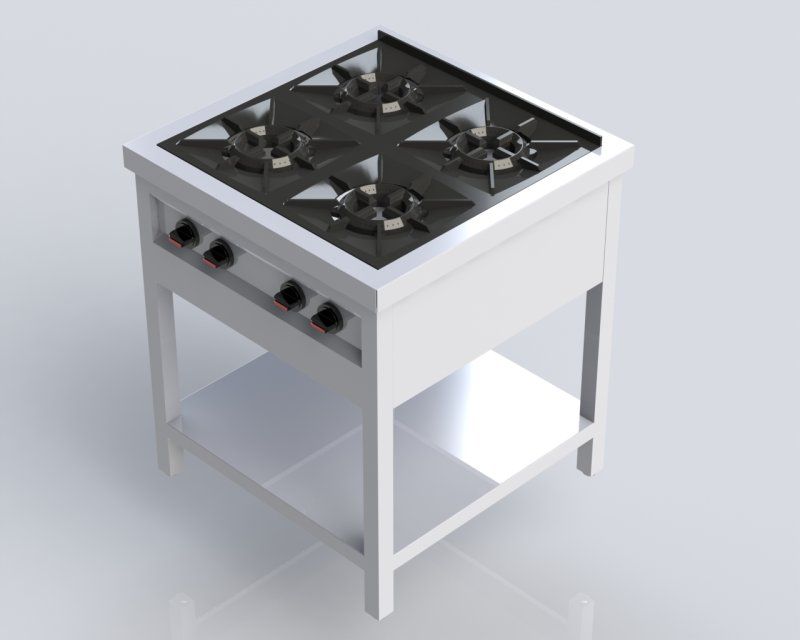
A commercial kitchen is an intense thermodynamic environment. Every hour of high-heat cooking releases gallons of vaporized cooking oil, airborne grease particulates, water vapor, smoke, and hazardous combustion gases like carbon monoxide. Without an engineered, high-performance commercial kitchen hood and exhaust system, these pollutants linger inside the building—coating walls in sticky grease, triggering respiratory distress among kitchen staff, and creating severe fire hazards.
In Kenya’s rapidly expanding restaurant and hotel sector—from multi-story urban buildings in Nairobi with long horizontal duct runs to coastal resorts in Mombasa facing extreme ambient heat and humidity—installing an arbitrary sheet-metal box and domestic extractor fan is a recipe for disaster.
In this comprehensive 2026 technical guide, Gacch Hospitality Equipment breaks down the complete engineering, airflow calculations, baffle filtration technology, duct fabrication, make-up air balancing, and fire safety compliance required for world-class commercial kitchen hood systems.
11. How Commercial Kitchen Extraction Systems Work
A complete commercial kitchen extraction system is not just an overhead hood; it is a balanced mechanical ventilation circuit comprising five interconnected components:
22. Choosing the Right Hood Canopy Configuration
The architecture of your cooking line determines the appropriate canopy design:
33. Engineering Airflow: The Science of CFM Calculations
An extraction fan must pull enough air to create a capture velocity that overcomes thermal buoyancy and cross-drafts in the kitchen without sucking away conditioned ambient air unnecessarily.
Airflow Sizing Guidelines:
The standard capture velocity across the face of a commercial canopy hood must be between 0.4 m/s and 0.6 m/s (80 to 120 FPM).
Standard Extraction Flow Rates by Cooking Category:
- Light Duty (Steam tables, electric ovens, soup kettles): 150 to 200 CFM per linear foot of hood.
- Medium Duty (Open gas ranges, griddles, electric fryers): 250 to 350 CFM per linear foot of hood.
- Heavy Duty (Gas deep fryers, charbroilers, wok ranges, lava rock grills): 350 to 450+ CFM per linear foot of hood.
$$ ext{Required Airflow (CFM)} = ext{Hood Length (ft)} imes ext{Duty Factor (CFM/ft)}$$
Example: A 12-foot (3.6-meter) heavy-duty cooking line containing two double gas fryers, a charbroiler, and a 6-burner gas range requires: $$ ext{Airflow} = 12 ext{ ft} imes 400 ext{ CFM/ft} = \mathbf{4,800 ext{ CFM}}$$
Featured Commercial Machinery & Fabrication
Explore turnkey kitchen appliances engineered and installed by Gacch Hospitality across Kenya.

Ventilating Fan for Fumes, Smoke, Moist or dusty + RPM 1400, .25 kW. 6880mc/h. Range -20°C/+40°C. Axial type Ø500mm
- Continuous TIG-Welded 304 Stainless Steel Canopy
- Removable Stainless Baffle Grease Filters
- Low-Noise High-CFM Centrifugal Blower Integration
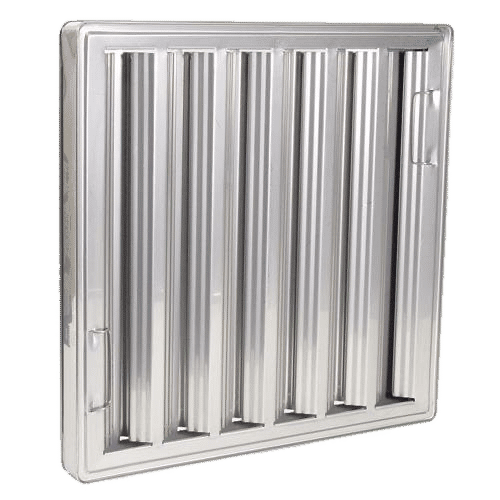
Stainless Steel Grease Filter S-Shaped + Fire Retardant with Drip Holes, Multidirectional Vapor and Oil Filtration System
- Continuous TIG-Welded 304 Stainless Steel Canopy
- Removable Stainless Baffle Grease Filters
- Low-Noise High-CFM Centrifugal Blower Integration
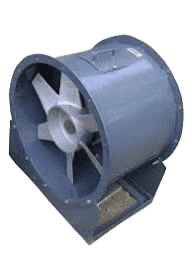
Ventilating Fan for Fumes, Smoke, Moist or dusty + RPM 1400, 25kW, 4370mc/h Range -20°C/+40°C Axial Type Ø400mm
- Continuous TIG-Welded 304 Stainless Steel Canopy
- Removable Stainless Baffle Grease Filters
- Low-Noise High-CFM Centrifugal Blower Integration
44. Baffle Filters vs. Mesh Filters: Why Baffles Are Non-Negotiable
Under KEBS food safety standards and global fire safety codes (NFPA 96), wire mesh filters are strictly prohibited in commercial cooking canopies.
Why Baffle Filters Are Mandatory:
- Centrifugal Impingement Principle: Stainless steel baffle filters force grease-laden air to make a series of rapid, 180-degree directional turns. Heavy grease particles cannot turn the corner and are thrown against the stainless steel vanes, condensing into liquid oil and draining down into a collection cup.
- True Flame Barrier: In the event of a flare-up or fryer fire on the cooking line, interlocking baffle vanes prevent direct flames from entering the grease-coated ductwork above.
- Effortless Cleaning: 304 stainless steel baffle filters can be removed in seconds and washed in a commercial dishwasher daily.
55. Exhaust Fans: Centrifugal Backward-Curved Blowers
Axial propeller fans (like domestic wall fans) lose up to 80% of their airflow when connected to ductwork. Commercial kitchen extraction requires high-static pressure Centrifugal Blowers with backward-curved impellers:
- Motor Sizing: 1.5 kW to 5.5 kW (415V Three-Phase) depending on total duct static pressure (measured in Pascals or inches water gauge).
- External Mounting: Blowers should be mounted externally (on the building roof or exterior wall) to create negative pressure throughout the entire duct run inside the building. This ensures that even if a duct joint has a micro-leak, air is pulled into the duct rather than leaking smoke into the restaurant.
- Vibration Isolators & Weather Cowls: High-grade rubber dampers eliminate structure-borne motor humming in dining rooms below.
66. The Critical Role of Make-Up Air (Fresh Air Balancing)
When a commercial hood extracts 5,000 CFM of air, that air must be replaced. If a kitchen has no dedicated make-up air supply:
- The kitchen develops severe negative air pressure.
- Service doors become difficult to push open or slam shut violently.
- Smoke and soot are pulled back down furnace flues and bathroom drains.
- Hot exterior air is sucked through dining room doors, overloading air conditioning systems.
The Solution: Gacch Hospitality engineers balanced make-up air systems that reintroduce 80% to 85% filtered, tempered fresh air directly into the front perimeter of the hood canopy (air-curtain capture) or through perforated ceiling diffusers.
77. Duct Fabrication, Core Drilling & Fire Safety Regulations
In Kenya, kitchen exhaust fires represent one of the top operational risks in commercial buildings.
- Duct Metallurgy: Fabricated from minimum 1.2mm (18-gauge) black mild steel or 1.0mm 304 stainless steel with continuous liquid-tight welded seams.
- Inspection Access Hatches: Liquid-tight gasketed access panels must be installed every 3 meters along the duct run and at every 90-degree bend to enable quarterly high-pressure chemical degreasing.
- Fire Suppression Systems: Premium commercial installations integrate automatic wet-chemical fire suppression systems (e.g., Ansul R-102) with discharge nozzles aimed directly into the fryer vats and duct collars, linked to an automatic gas shutoff valve.
88. Sizing and Budgeting Your Extraction System
To see how commercial kitchen ventilation fits into your overall capital expenditure, review our comprehensive commercial kitchen equipment costs in Kenya guide or check the complete appliance audit in The Ultimate Restaurant Kitchen Equipment Checklist.
9Frequently Asked Questions (FAQ)
How often should commercial kitchen hood filters be cleaned?
Stainless steel baffle filters should be removed and washed in hot soapy water or run through a commercial dishwasher daily or every two days in high-volume kitchens.
Can kitchen extraction ducting be connected to the building's general HVAC ducting?
No, absolutely not. Commercial kitchen extraction ducts carry flammable grease aerosol and must run as a dedicated, fire-rated independent riser directly to the external building envelope or rooftop.
What causes a commercial kitchen hood to drip grease onto food?
Grease dripping occurs when baffle filters are saturated, when the extraction canopy lacks an integrated perimeter grease gutter with drain pitch, or when horizontal duct runs lack proper slope toward grease cleanout ports.
10Upgrade to a Precision-Engineered Kitchen Extraction System
Don't let smoke, heat, and grease ruin your restaurant’s kitchen environment and customer experience.
At Gacch Hospitality Equipment, our HVAC and stainless steel engineers custom-fabricate and install high-performance commercial kitchen hood and extraction systems across Kenya. From 3D airflow modeling and heavy-duty 304 canopies to high-efficiency centrifugal blowers and make-up air units, we guarantee optimal ventilation and complete fire safety compliance.
👉 Request a Kitchen Extraction System Engineering Survey with Gacch or call +254 714 349555 to discuss your building layout today.